
Nucleation and Growth of Sedimentary Minerals
Year of publication: 2025
Authors: Patrick Hadrian Meister, Cornelius Fischer, Nereo Preto
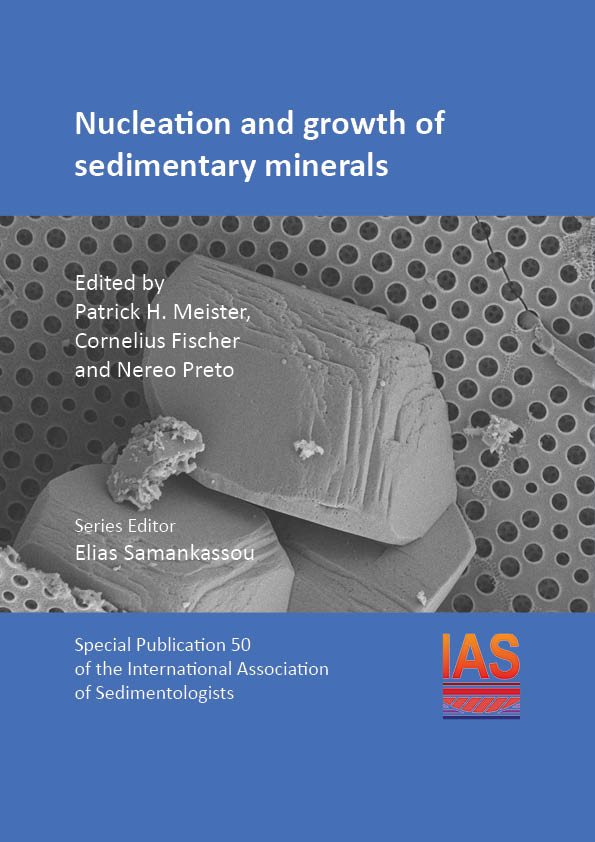
Minerals nucleating and growing under Earth surface conditions, referred to here as sedimentary minerals, make up a significant portion of the sedimentary record. Yet, unlike in the Earth’s interior, these processes often proceed slowly or are entirely inhibited at low temperatures. Metastable minerals commonly appear first and exhibit various forms, such as spherulites, crystal fans or laminated structures. What mechanisms drive their formation? Which thermodynamic and kinetic factors control them – and what role does life play in these processes?
Recent observations of ‘non-classical’ pathways, in which nanoparticles nucleate, aggregate and ripen into stable phases, have provided new perspectives into mineral formation. But which factors are decisive for the specific pathways? What consequences do these pathways have for the composition of minerals and the preservation of geochemical proxies?
These questions are at the heart of this volume, which brings together 23 chapters covering theoretical concepts, experimental studies, computer models and natural examples from environments ranging from alkaline lakes and marine settings to diagenetic systems and the geological record of deep-time. Together, these chapters explore the mechanisms of nucleation and growth of sedimentary minerals, as well as their significance as archives of Earth history.
Chapters
Chapter Name / Number
Page
Introduction to the nucleation and growth of sedimentary minerals (Meister, P.H., Fischer, C. and Preto, N). DOI: 10.54780/IASSP50/01
-
Thermodynamics and kinetics of mineral surface reactions in ambient solutions (Meister, P.H. and Böttcher, M.E.). DOI: 10.54780/IASSP50/02
1
Classical and nonclassical models of crystal formation: conflicting but complementary (Wolf, S.E.). DOI: 10.54780/IASSP50/03
41
Review on the formation and transformation behaviour of amorphous calcium carbonate and its control on environmental proxies (Brazier, J.-M., Pettauer, M., Götschl, K.E. and Dietzel, M). DOI: 10.54780/IASSP50/04
66
Ostwald’s step rule: a consequence of growth kinetics and nano-scale energy landscape (Meister, P.H.). DOI: 10.54780/IASSP50/05
87
Modelling nucleation and growth (Valentini, L). DOI: 10.54780/IASSP50/06
107
Dolomite formation processes: insights from laboratory and field investigations (Szucs, A.M. and Rodriguez-Blanco, J.D.). DOI: 10.54780/IASSP50/07
123
The effect of physicochemical oscillations on the formation of dolomite and magnesite (Pimentel, C. and Pina, C.M.). DOI: 10.54780/IASSP50/08
151
Spherulitic mineral growth: auto-deformation, growth front nucleation or semi-oriented attachment? (Meister, P.H.). DOI: 10.54780/IASSP50/09
171
Spherulitic mineral growth: an unreliable biosignature but a great process indicator (Meister, P.H. and Wolf, S.E.). DOI: 10.54780/IASSP50/10
190
Hydrated Mg-carbonate microbialites of Lake Salda, Turkey: Biotic and abiotic processes (Balci, N.). DOI: 10.54780/IASSP50/11
212
Carbonate crystal fans: Geologic occurrences and controls on growth (Woods, A.D.). DOI: 10.54780/IASSP50/12
238
Microbialites as archives for palaeo-seawater trace element composition – two case studies from the Triassic of the Dolomites (northern Italy) compared (Preto, N., Borsato, A., Carampin, R., Della Porta, G., Frisia, S., Gattolin, G., Klügel, A., Himmler, T., Westphal, H. and Zorzi, F.). DOI: 10.54780/IASSP50/13
266
Early diagenesis in speleothems and preservation of their palaeoclimate properties: the case of Middle Pleistocene flowstones from Grotta di Collalto (Dolomites, Italy) (Martín-García, R., Frisia, S., Borsato, A. and Hellstrom, J.). DOI: 10.54780/IASSP50/14
301
Formation of dolomite in methane seep environments (Lu, Y., Lin, Z., Chen, T. and Peckmann, J). DOI: 10.54780/IASSP50/15
328
Neoproterozoic stromatolite mineralogy in Murchisonfjorden (Svalbard, Norway) reflecting variable depositional environments (Szucs, A.M., Maddin, M., Meister, P.H., Drakou, F., Stavropoulou, A., Faulkner, N. and Rodriguez-Blanco, J.D.). DOI: 10.54780/IASSP50/16
347
Barite in Baltic freshwater sediments crystallises in a diffusive salinisation gradient (Roeser, P., Böttcher, M.E., Lapham, L.L., Halas, S., Pretet, C., Nägler, T.F., Prieto, M., Struck, U. and Huckriede, H). DOI: 10.54780/IASSP50/17
370
From the rock to the precursor: sedimentary iron and manganese minerals as records of an evolving early Earth (Tsikos, H., Jiang, C.Z., Tostevin, R., Mhlanga, X.R., Nke, A.Y., Siahi, M. and Mason, P.R.D.). DOI: 10.54780/IASSP50/18
396
Mineral surface reactions and mechanisms during sandstone diagenesis (Fischer, C.). DOI: 10.54780/IASSP50/19
421
The formation of authigenic clay minerals in clastic sedimentary rocks (Wilkinson, M). DOI: 10.54780/IASSP50/20
446
Diagenetic complexities of iron oxide cements in Mesozoic sandstones of the Colorado Plateau Utah, U.S.A. (Potter-McIntyre, S.L. and Chan, M.A.). DOI: 10.54780/IASSP50/21
463
Numerical simulation of twin concretion formation (Sirono, S., Kajiura, T., Katsuta, N., Yoshida, H. and Chan, M.A.). DOI: 10.54780/IASSP50/23
508
Diagenesis of clastic pipes of the Jurassic Carmel Formation, Southern Utah: evidence for preferential fluid pathways (Wheatley, D.F., Chan, M.A. and Bowen, B.B.). DOI: 10.54780/IASSP50/22
486
Spatial distribution and size variation of iron oxide concretions in Navajo Sandstone (Sirono, S. and Tamura, M.). DOI: 10.54780/IASSP50/24
521
Szucs_et_al_Supplementary_Information
-
Diagenesis of clastic pipes of the Jurassic Carmel Formation, Southern Utah: evidence for preferential fluid pathways [Supplementary Information]
-
Barite in Baltic freshwater sediments crystallises in a diffusive salinisation gradient [Supplementary Information]
-
Microbialites as archives for palaeo-seawater trace element composition – two case studies from the Triassic of the Dolomites (northern Italy) compared [Supplementary Information]
-
About this book
Year of publication
2025
Author/s
Patrick Hadrian Meister, Cornelius Fischer, Nereo Preto
Description
Minerals nucleating and growing under Earth surface conditions, referred to here as sedimentary minerals, make up a significant portion of the sedimentary record. Yet, unlike in the Earth’s interior, these processes often proceed slowly or are entirely inhibited at low temperatures. Metastable minerals commonly appear first and exhibit various forms, such as spherulites, crystal fans or laminated structures. What mechanisms drive their formation? Which thermodynamic and kinetic factors control them – and what role does life play in these processes?
Recent observations of ‘non-classical’ pathways, in which nanoparticles nucleate, aggregate and ripen into stable phases, have provided new perspectives into mineral formation. But which factors are decisive for the specific pathways? What consequences do these pathways have for the composition of minerals and the preservation of geochemical proxies?
These questions are at the heart of this volume, which brings together 23 chapters covering theoretical concepts, experimental studies, computer models and natural examples from environments ranging from alkaline lakes and marine settings to diagenetic systems and the geological record of deep-time. Together, these chapters explore the mechanisms of nucleation and growth of sedimentary minerals, as well as their significance as archives of Earth history.
Series Editor
Elias Samankassou
Subject/s
minerals, sedimentary, nucleation and growth, metastable, spherulites, crystals, kinetics, precipitation, geochemical proxies
Last updated
04 March 2026
Copyright status
©2025 International Association of Sedimentologists. ISBN 978-1-7398845-2-9
How to access
Get access to publications, books, grants and more with your IAS membership